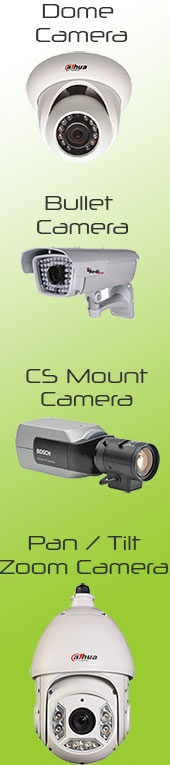
Some terminology you may encounter regarding your camera selection would be:
• Wide Dynamic Range (WDR) which refers to the cameras ability to capture clear images of objects surrounded by a strong back light, while still keeping the background visible. This would be used in a variable light environment.
• CCD or CMOS – This is the sensor which captures the image onto the camera and is at the heart of the camera. The 1/3” typically referred to is size of the sensor.
• LUX Level – LUX Levels refer to the lighting conditions the camera can operate in. Here is a chart to help you understand LUX Levels
0.0001 LUX |
Poor Starlight |
5 LUX |
Average street light |
0.001 LUX |
Normal Starlight |
10 LUX |
Sunset |
0.1 LUX |
Normal Moonlight |
15 LUX |
Good street lighting |
0.3 LUX |
Full Moonlight |
300 LUX |
Minimum requirement for easy reading |
1 LUX |
Twilight |
500 LUX |
Well lit room |
2 LUX |
General minimum lighting for security |
5000 LUX |
Overcast Day |
• IR (Infrared) – Most cameras would typically be equipped with IR illumination. This gives a camera the ability to work in near zero lighting conditions. Bear in mind, when a camera switches to “black and white”
• DN – Day / Night camera. This is if a camera either has IR or can work in very low lighting conditions.
• IP65 (or other number) – This refers to the “Ingress Protection” of a camera or device. Typically an “outdoor” product will be rated at IP65. The 6 being dust-proof and the 5 being waterproof to sprays of water. 66 would be heavy jets of water, 67 is partial submersion in water and 68 being permanent submersion in water. Click here to view this handy IP Chart.
• “x”mm lense: Typically “fixed” lenses will have just one number – generally 4 or 6mm. This means the camera lens cannot be adjusted and what you see is what you see. If a lens however has a range (typically 3 to 9mm or 2.8 to 12mm adjustment is available. The larger the mm number, the further the camera can be “zoomed” in.)
• “x” TVL or TV Lines: This refers to both cameras (typically analogue) and monitors resolution ability. A “standard” analogue camera will typically have around 400TVL while a better quality camera will have 800TVL.
• Auto Iris: If a camera has auto-iris, this means it can adjust the amount of light being let in and would typically be used where there are variable lighting conditions which e.g. a petrol station with cars pulling up with headlights or a camera that pointed in the direction of the sunrise / sunset.

 Biometrics &
 Time &
 CCTV &
 Intruder
  Fencing &
 X-Ray & Metal
 IP and Smart Intercoms
  Fire
Fire  Public
  Networks & Wireless